
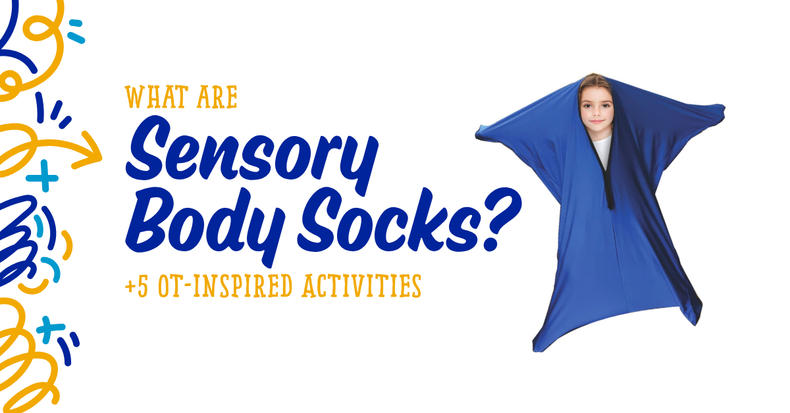
If you’ve ever watched your child crash into the couch, wrap themselves tightly in blankets, or squeeze into tiny spaces, you might have wondered: why do they seek so much pressure? A sensory body sock is a simple tool that can safely give that “full-body hug” feeling while also supporting movement, play, and regulation.
In this guide, you’ll learn what a sensory body sock is, who it can help, how to use it safely, and five easy, OT‑inspired activities you can try at home, school, or in therapy.
What Is a Sensory Body Sock?
A sensory body sock is a stretchy fabric “pouch” kids (and sometimes adults) can climb into so their whole body is gently compressed. The material provides resistance as they push, stretch, and curl, which gives deep pressure and proprioceptive input (feedback about where their body is in space).
Think of it like a wearable stretchy blanket:
-
It offers a calming, “wrapped up” feeling.
-
It gives kids a safe way to push, pull, and move against resistance.
-
It can be used for both calming and playful movement, depending on the activity.
At AdaptStore, our sensory body sock is designed to be soft, breathable, and stretchy, with enough space for kids to stand, sit, or lie down while still feeling contained and supported.

Who Can Benefit from Sensory Body Socks?
Every child is different, but body socks are often helpful for children who:
-
Seek big movement and pressure (crashing, jumping, bumping into things).
-
Have autism, ADHD, or sensory processing differences.
-
Struggle with body awareness and coordination.
-
Find it calming to be wrapped, hugged, or tucked in tightly.
A sensory body sock can be used:
-
At home as part of a calming routine or playtime.
-
In classrooms or learning spaces as a movement break.
-
In therapy settings as part of an occupational therapist’s sensory plan.
If your child tends to avoid tight clothing or being wrapped up, a body sock might not be their favourite tool, and that’s okay. Sensory regulation is very individual.
Are Body Socks Safe for Kids?
When used with supervision and some simple guidelines, body socks can be a safe and effective sensory tool.
Keep in mind:
-
Always supervise, especially with younger children.
-
Make sure your child can get in and out easily and can breathe comfortably.
-
Use on a suitable surface (carpet, mat, or puzzle mats) away from sharp corners or furniture edges.
-
Avoid using it when your child is very upset, overheated, or ill.
-
Follow any recommendations from your child’s occupational therapist, if they have one.
You can start with short, low‑demand activities (like gentle “cocoon” time) and build up as your child becomes more comfortable.
5 OT-Inspired Body Sock Activities to Try
You don’t need to be a therapist to use a body sock well. Here are five simple, OT‑inspired ideas you can adapt to your child’s age, interests, and abilities. You can also pair these with other sensory tools like weighted stuffies, floor mats, or visual timers.
1. The Calm Cocoon
Goal: Calming, grounding, and body awareness.
How to do it:
-
Have your child sit or lie down inside the body sock in a comfortable position.
-
Gently stretch the fabric around them so they feel evenly wrapped, like a snug sleeping bag.
-
Dim the lights, add a favourite weighted stuffed animal to hug, or play soft music.
-
Encourage slow breathing: “Smell the flower” (breathe in) and “blow out the candle” (breathe out).
When to use:
-
After school, before bed, or after a busy outing.
-
As part of a calm-down routine when they are starting to feel overwhelmed (but not at peak meltdown).
Need a companion? Our Weighted Stuffed Animals make a perfect Calm Cocoon Companion!

2. Animal Walks
Goal: Heavy work, motor planning, and fun movement.
How to do it:
-
Have your child climb into the body sock and stand up.
-
Call out different animals and let them move across the room in character:
-
“Turtle” – slow, low crawling.
-
“Bear” – big, strong steps.
-
“Snake” – lying on the floor and wiggling across a mat.
-
-
If you have sensory puzzle mats or foam tiles, lay them out as a “trail” to walk, crawl, or stomp on.
When to use:
-
Before homework or seated tasks to get “heavy work” input.
-
As a movement break between activities.
If you're looking for sensory puzzle mats to add to the experience - Check out our Set of 7!

3. Push and Stretch
Goal: Deep pressure and controlled resistance.
How to do it:
-
Have your child stand inside the body sock.
-
Ask them to push their hands, feet, or back against the fabric as if they’re trying to “make the sock grow.”
-
Turn it into a game:
-
“Push the wall” – press both hands out in front.
-
“Growing tree” – push arms up tall.
-
“Superhero shield” – push forward and hold for a count of 5–10.
-
-
Encourage slow, strong movements rather than quick, frantic pushing.
When to use:
-
When your child seems “wiggly” and needs something strong to push against.
-
As part of a morning routine to organize their body before school.
4. Freeze Dance in the Sock
Goal: Regulation, impulse control, and listening skills.
How to do it:
-
Put on some music your child loves.
-
While inside the body sock, let them dance, jump, or wiggle.
-
Pause the music at random moments and call “Freeze!”
-
During the “freeze,” they try to hold a pose while feeling the fabric pressing back against their body.
When to use:
-
As a playful way to burn energy on indoor days.
-
Before transitions that usually feel hard (like turning off screens).
This can be easily adapted for siblings or classmates—one child in the sock, others join without it, then swap.
5. Obstacle Path Challenge
Goal: Coordination, sequencing, and proprioceptive input.
How to do it:
-
Create a simple obstacle path with what you have:
-
Step across puzzle mats or cushions.
-
Step over a pillow or roll under a low string.
-
Sit and spin slowly, then stand and walk to the end.
-
-
Have your child move through the path while inside the body sock.
-
Start very simple and add one new “challenge” at a time based on their comfort and safety.
When to use:
-
As a structured “sensory break” during homework or homeschool time.
-
In a therapy room or classroom with clear boundaries and supervision.
How to Choose the Right Sensory Body Sock
When you’re ready to pick a body sock for your child, keep these points in mind:
-
Size: Usually based on height range. The sock should be tall enough for your child to fully extend but not so long that they’re tripping over excess fabric.
-
Stretch and thickness: You want enough resistance to feel the pressure, but still easy to move and breathe.
-
Opening: Look for a design that is simple to climb into and climb out of independently.
-
Environment: Think about where you’ll use it most (small apartment vs. classroom vs. clinic) and choose a size and storage option that fits your space.
Explore Our Selection Here
Supporting Canadian Families: The AdaptAbilities Mission
Every purchase from AdaptStore.ca directly supports AdaptAbilities' programs, helping more Canadian families access the sensory support they need. As a nonprofit organization, AdaptAbilities understands that sensory support tools aren't luxuries - they're necessities that can transform a child's ability to participate successfully in home, school, and community activities.
The right sensory tools can transform daily struggles into successful experiences, whether at home, school, or in the community. For many families, investing in sensory support tools is the key to unlocking their child's potential and creating a more peaceful, successful daily life.
Ready to start your sensory support journey? Browse our complete collection of research-backed sensory products at AdaptStore.ca. With our Edmonton local pickup option, affordable shipping rates, and commitment to supporting Canadian families, we're here to help your child thrive.